Annual Salary or Annualised Wage?
Why the Difference Matters
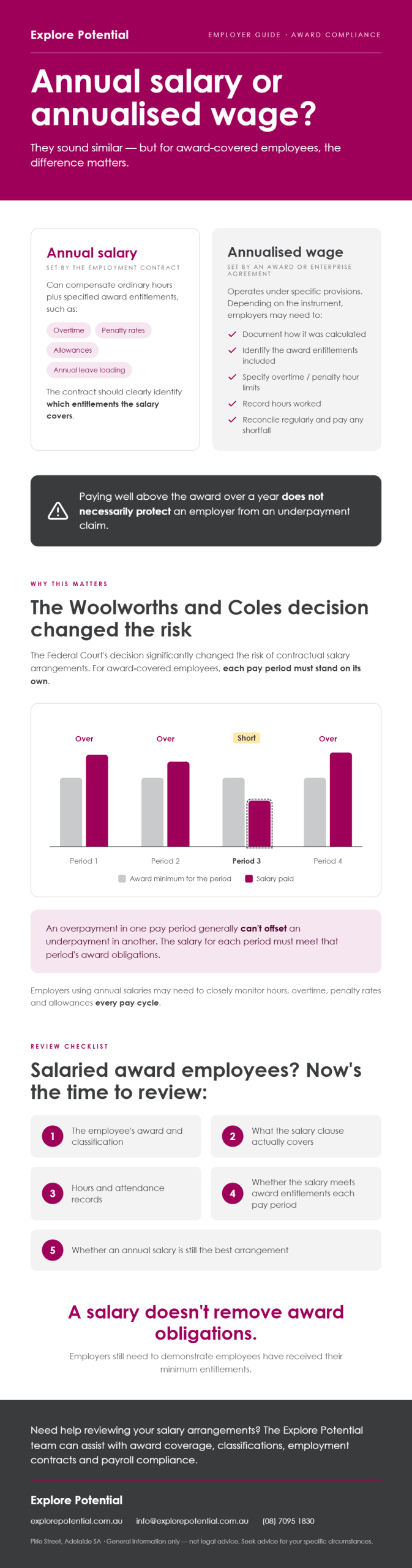
An annual salary and an annualised wage arrangement sound similar, but for award-covered employees the difference is important. Getting it wrong can expose you to underpayment claims, even if you’re paying well above the award.
Read on to understand the difference, why it matters, and what to review now. You can also download our infographic to share with your team or keep handy.
Annual salary
An annual salary is usually agreed in the employment contract. It can cover an employee’s ordinary hours and specified award entitlements, such as:
- overtime
- penalty rates
- allowances
- annual leave loading.
The contract should clearly state which entitlements the salary is intended to cover.
Paying an employee well above the award over a year doesn’t necessarily protect you from an underpayment claim.
Annualised wage arrangement
An annualised wage arrangement operates under specific provisions in a modern award or enterprise agreement. Depending on the instrument, employers may need to:
- document how the annualised wage was calculated
- identify the award entitlements it includes
- specify limits on overtime or penalty hours
- record the hours worked
- reconcile regularly and pay any shortfall.
Why this matters: the Woolworths and Coles decision
The Federal Court’s decision in the Woolworths and Coles cases significantly changed the risk of contractual salary arrangements.
For award-covered employees, each pay period must stand on its own. Employers generally can’t use an overpayment in one pay period to make up for an underpayment in another. The salary paid in each period must meet the award obligations for that same period.
For example, say an employee works heavy overtime in one fortnight. A salary that comfortably covers a normal fortnight may fall short for that period, even if the employee is paid well above the award across the year.
That means employers using annual salaries may need to closely monitor hours, overtime, penalty rates and allowances every pay cycle.
Key takeaway for employers
If you employ salaried staff who are covered by an award, now is a good time to review:
- The employee’s award and classification. Make sure both are correct.
- What the salary clause actually covers. Check that it clearly lists the entitlements it is meant to absorb.
- Hours and attendance records. You’ll need them to show compliance.
- Whether the salary meets award entitlements in each pay period, not just across the year.
- Whether an annual salary is still the best arrangement, or whether an award-based annualised wage arrangement would suit better.
A salary doesn’t remove award obligations. Employers still need to be able to show that employees have received their minimum entitlements.
How Explore Potential can help
Not sure whether your salary arrangements stack up? The Explore Potential team can help with:
- award coverage and classifications
- reviewing and drafting salary clauses and employment contracts
- payroll compliance checks and reconciliations
- a practical plan to fix any gaps before they become a claim.
Got a question? We’re here to help
If you’d like to talk through your salaried employees, or any other HR question, get in touch with the Explore Potential team:
This article is general information only and isn’t legal advice. Please seek advice for your specific circumstances.